In today’s fast-moving media landscape, understanding the distinction between above-the-line (ATL) and below-the-line (BTL) marketing is fundamental. For brands operating across the UK and the USA, knowing when, where, and how to deploy each approach can make the difference between a campaign that underperforms and a campaign that delivers real value.
At The Media Planning & Buying Agency, we specialise in designing and executing integrated media strategies that leverage both ATL and BTL tactics, tailored for both the UK and US markets. In this blog, we’ll break down what ATL and BTL marketing actually mean, compare them side-by-side, and explore best practice usage.
What Is Above The Line (ATL) Marketing?
Above-the-line marketing is a broad, untargeted strategy that uses mass media to build brand awareness among a wide audience. Channels typically associated with ATL include television, radio, print newspapers and magazines, out-of-home (billboards, transit) and large-scale digital display when used for broad reach.
Key features of ATL include:
- Broad targeting, the aim is to reach large segments of the population
- Brand awareness and image building, rather than immediate conversions
- Measured in terms of reach, frequency, and impressions rather than leads/sales
- Typically relies on traditional mass media channels
What Is Below The Line (BTL) Marketing?
Below-the-line marketing is a targeted promotional strategy that uses direct, personalised methods such as direct mail, email, events, experiential marketing, influencer collaborations, social media, and in-store promotions to reach specific audiences rather than mass audiences. BTL aims to foster direct engagement, build customer loyalty, and drive specific actions such as purchases or sign-ups. There is a focus on measurable outcomes such as leads, conversions, and engagements.
Key features of BTL include:
- Narrow audience targeting, specific segments, regions, behaviours
- Measurable actions, click-throughs, leads, conversions, purchases
- More flexibility in budget allocation, flighting, and direct feedback loops
- Especially useful when you want to activate a brand rather than just build.
ATL vs BTL Marketing: Side by Side
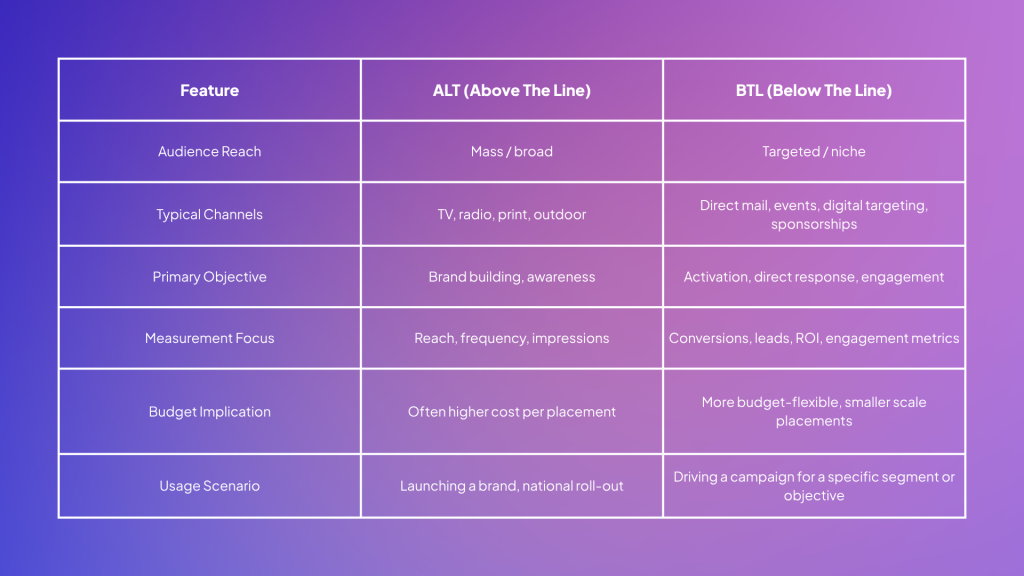
When planning media, the choice isn’t always “one or the other”, the most effective strategies typically combine both ATL and BTL. For example, a brand might build mass awareness via radio or TV (ATL) and then retarget engaged users with a focused email or digital campaign (BTL).
When to Use ATL or BTL? Best Practice Guidance
The following is our recommended best-practice guidance:
- Define the Objective
Start by asking: Is the goal brand awareness (broad) or activation (specific response)? If you’re launching a new brand or positioning, ATL should play a bigger role. If you have an existing audience and want to drive action, BTL may lead.
- Consider Your Market (UK vs USA)
The media landscapes in the UK and the USA differ: for instance, TV and OOH costs, audience habits and regulatory environments vary. In the UK, public-service broadcasters still command a significant share; in the USA, fragmented cable/streaming markets and localised OOH give different options. Tailor your plan accordingly.
- Budget Allocation & Media Mix
Don’t assume 50:50 ATL:BTL always works. Instead, model expected reach, engagement, and cost per outcome. For a brand campaign across the UK and the USA, you might allocate 60% of the budget to ATL for broad reach, and 40% to BTL for targeted follow-up, but this will depend on goals.
- Measurement & Optimisation
While ATL has more complex measurement (longer-term brand lift, reach models), BTL delivers more immediate metrics (leads, conversions). We recommend integrating both: track reach and awareness for ATL, alongside direct response metrics for BTL, and optimise mid-campaign.
- Use an Integrated Approach
The most effective campaigns in both the UK and the USA use an integrated mix of ATL + BTL. For example, a national TV/OOH spot (ATL) followed by digital retargeting and event activation (BTL) achieves both brand penetration and measurable action.
Understanding the difference between above-the-line and below-the-line marketing is about deploying the right strategy for your objectives, your market (UK vs USA), and your audience. With the right mix of ATL and BTL, you can build brand awareness, activate audiences and ultimately drive return.
At The Media Planning & Buying Agency, we specialise in helping brands navigate this complexity and deliver integrated, effective media plans across both regions.
Ready to launch your next campaign or optimise your media mix? Get in touch and let’s discuss how we can tailor a strategy for you.